Hello and welcome to the continuation of our blog series posts on Oracle’s PeopleSoft Global Payroll and Absence Management.
Ever wondered what it takes to make Absence configurable and process? The foundation of Global Payroll and Absence Management is unique – one that differentiates itself from other modules. This is what makes the module configurable to your company-specific needs. Let’s drive right in and learn!
What is an Element?
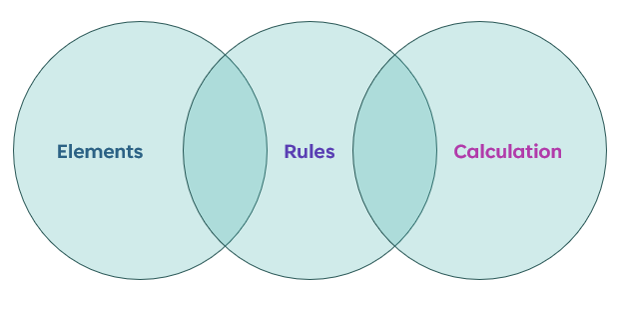
The Global Payroll and Absence Management product module is architected and designed with the use of Elements. Elements are the smallest building blocks of the module. Think of these elements as atoms! Like how an atom is the building block of the elements around us, Elements in Absence are the foundation block for rule building, individual components, and other structures for multi-purpose functionality. Each of the Elements designed are the building blocks used to define the Absence system. The Elements are defined only once and are used repeatedly anywhere in the system for multiple purposes.
Absence has different types of Elements – each one being able to do specific tasks. Let’s break them down.
· Data retrieval - Retrieve data (pre-defined system elements, custom)
· Calculation - Performs calculations (Sections, Process Lists, Run Types)
· Organizational - Structure & Framework (Pay Entity, Pay Groups)
· Primary - Take & Entitlement rule configuration
· Supporting - Joined Elements (Accumulators, Arrays, Brackets, Formulas, Variables, etc.)
· Other - Eligibility, Other Rules & Non-Rules based
These different types of Elements can be combined in unlimited ways to produce the specific results that you need for your Absence processing.
Using Elements in Rule Processing
With Absence Management, you can store rules by entering data or configuring Element-based designs through an online page framework.
The Element-based “rules” drive the core application functionality and defines how you want the system to process. A rule is what defines how the element is calculated to achieve a specific outcome. The Element-based “rules” then define the Absence Management process itself.
Every Country pre-defined or configured in Absence Management defines its own rule set. You can define rules to meet the needs of your specific organization and business processes that then provide you with the outcome in your processing efforts.
Using and creating Elements that are tied to rule processing are utilized to generate an outcome. The Elements defined in your rule structure are processed by the system to achieve an expected, calculated result. In theory, you are creating your own algebraic equations and posting a calculated value!
I hope you enjoyed this post. Stay tuned as we continue our conversations on the Oracle PeopleSoft Global Payroll and Absence Management product module.